-
Challenging Chords
-
Introduction
The order in which you place your fingers onto the ukulele fretboard can make a huge difference with getting the fingers into the required shape for challenging chords. If you've ever played Twister then you'll know what I mean.
The finger placement order, along with the positioning of your hand and wrist, are ways in which you can learn to conquer challenging chords and take your playing to another level!
As with any challenging chord, there are also alternatives, which you can use to 'fake it while you make it', or which you might prefer and continue to use. Remember, there is no rule that says you have to strum or pick all the strings. In fact, check out the number of Xs that appear in guitar chord diagrammes. So, just drop a finger and don't strum that string.
You can never have enough options in your chord bag of tricks, as each song might suit a slightly different fingering better than the default chord. It's your call, but don't ever avoid a song just because a chord is too difficult to play. Improvise 🤔👊.
-
The E (Eek) Chord 😫
Option 1: The Default
At first glance the E major chord - the default fingering of which is used with sheet music and apps such as Chordify - looks like a finger twister. This chord is infamous amongst beginner ukulelists.
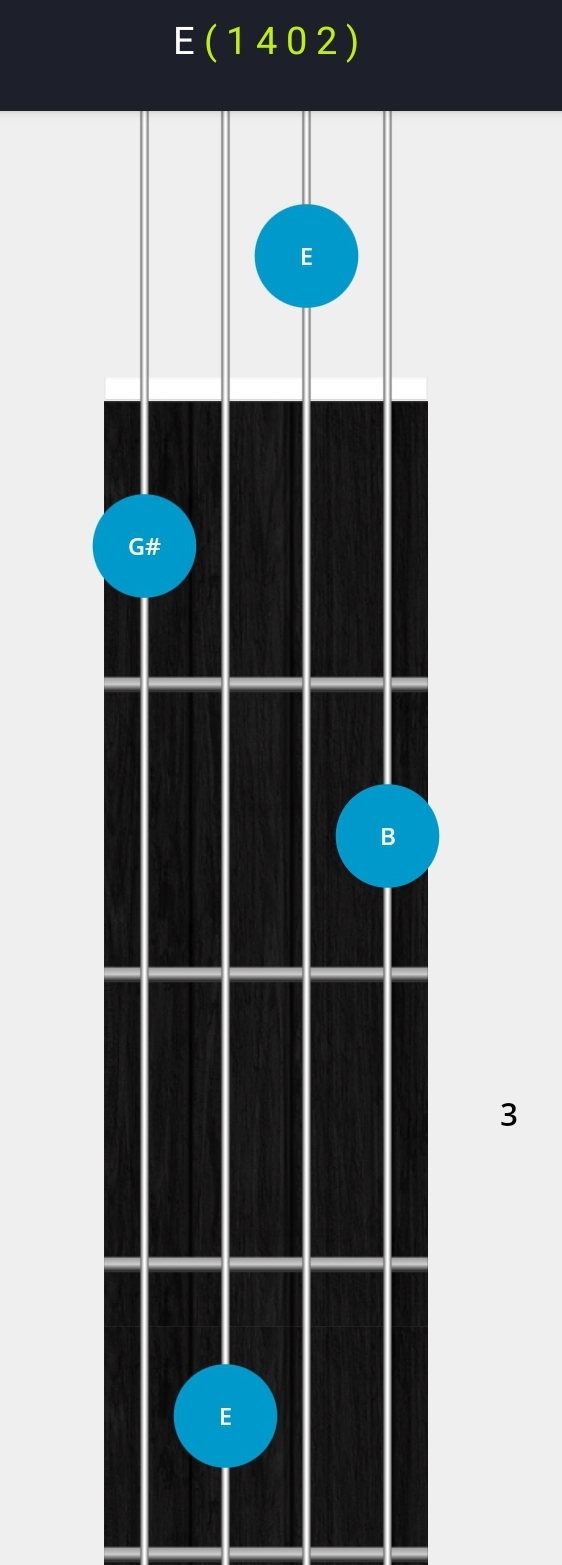
The order in which you place your fingers into position is especially important with this, the default E chord shape.
Resist the temptation to put down the first (index) finger onto the G# first. Instead, the fourth finger gets placed first onto the E note. Follow the diagramme below.
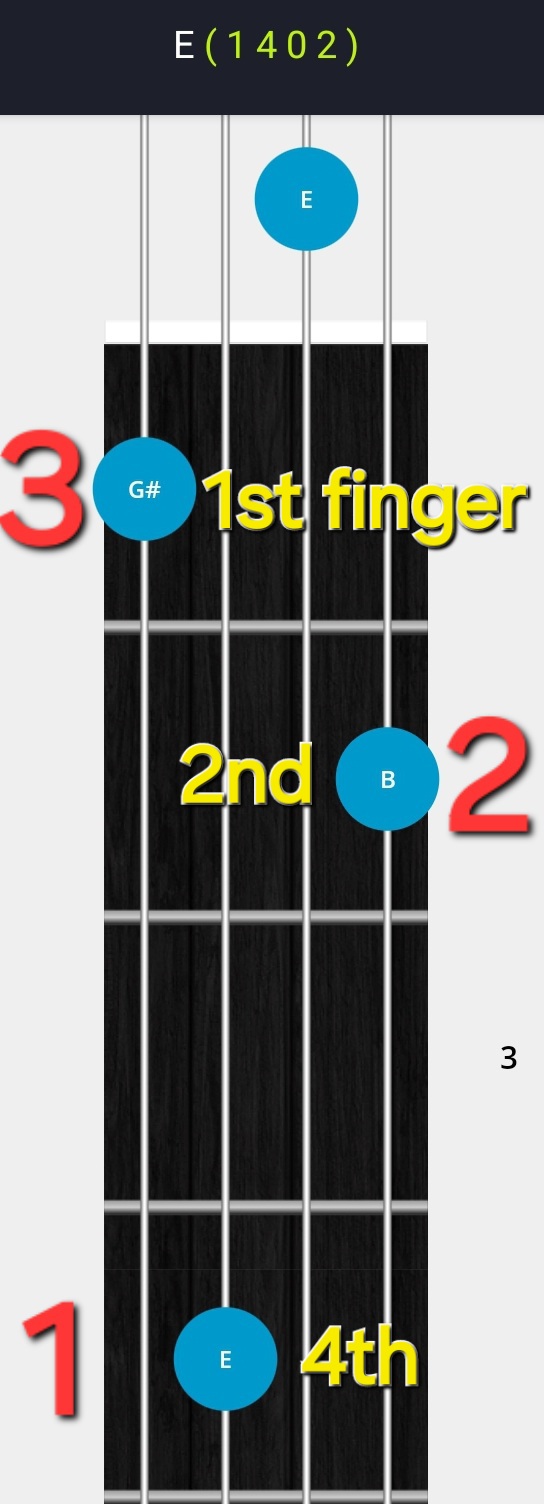
COMING SOON: I am also making a video to show you as there is a bit of a trick involved.
Depending upon the length and flexibility of your fingers and hand, you may choose to use different fingers. Go ahead and try out different finger combinations.
Now practise it in stages. Just the fourth and second finger. Then once you can place them easily into position add the first finger. Just don't do too much at first as you don't want to cause yourself pain or an injury.
Option 2: E7 from Heaven 😇
This was my go-to for ages when I first started my uke journey, even when it didn't sound quite right 🙉.
When I play in the key of A - a favourite key of mine - there is usually more than one instance of the E chord as it is the dominant chord in this key. If it sounds okay, then I usually make that E into an E7. It also then becomes a minimal movement to switch between A (2100) and E7 (1202). And as you know, I love minimal movements 🤣.
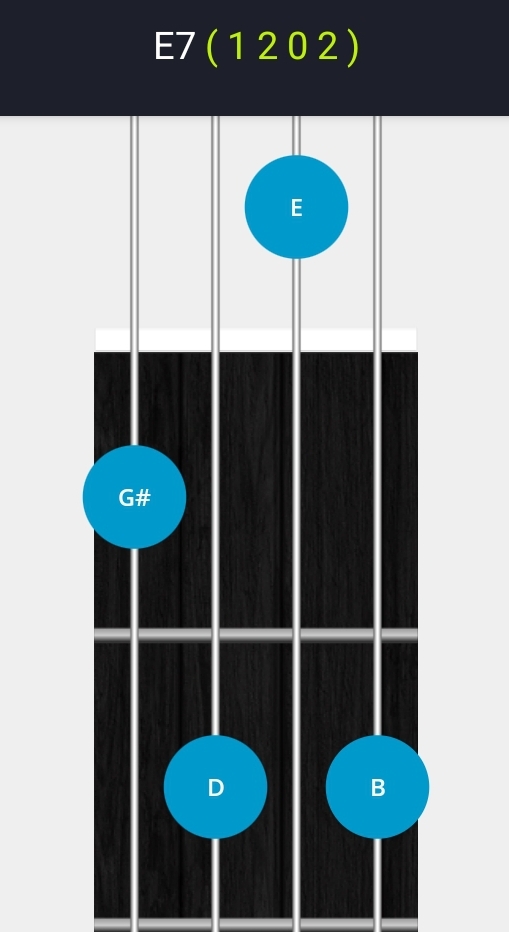
Some songs in the key of A that work with the E7 instead of E are Show a Little Kindness and Ring of Fire.
But, for those who live for a challenge, in the key of E (scar-E 😱) Blue Eyes Crying in the Rain. It also has an awesome rhythm that just yells "PLAY ME ON THE UKULELE!" As an aside, it has the next best thing to the Bb chord .... the B chord 😈😂.
Copy the following text into the search box on either ChordU or Chordify and instead of the E chord provided, play an E7. For the UB40 song, if you can't do a half-barre for the B, then play a B13 (4340). Hey mun, it's reggae after all 😅.
Uschool featuring Jan Arden Try a Little Kindness
Ring of Fire by Joaquin Phoenix
UB40 Blue Eyes in the Rain
Option 3: The D shaped E
This option for E involves a slight stretch. This stretch can be minimised by the position and angle of your wrist.
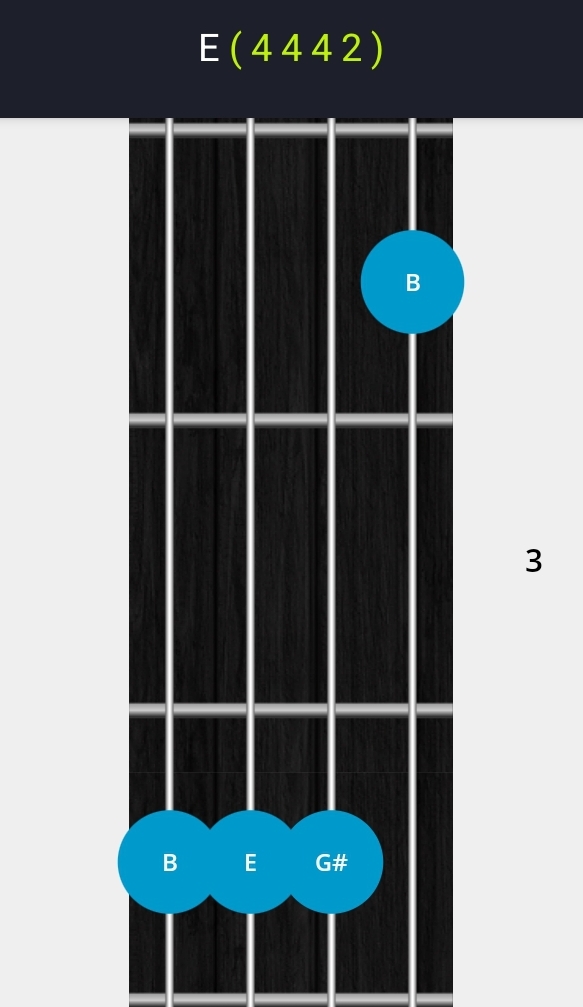
I get the second, third, and fourth fingers into position first. As this is the shape for the D chord my finger muscle memory kicks in. Next I tilt my hand and add the first finger to the B note on the first string.
A Video is Pending [It's hard to video this by yourself 😖.]
ChordU has seen the light, and uses this fingering in its app. Now if only Chordify would follow suit.
Option 4: E5 ✋️
If you already struggle with D (2220) due to large fingers/fingertips, then you can drop the third (G#) and play an open E to give you the E5 chord. This is a lovely sounding chord. It's rather neutral as it doesn't quite sound as if it is supposed to be major or minor.
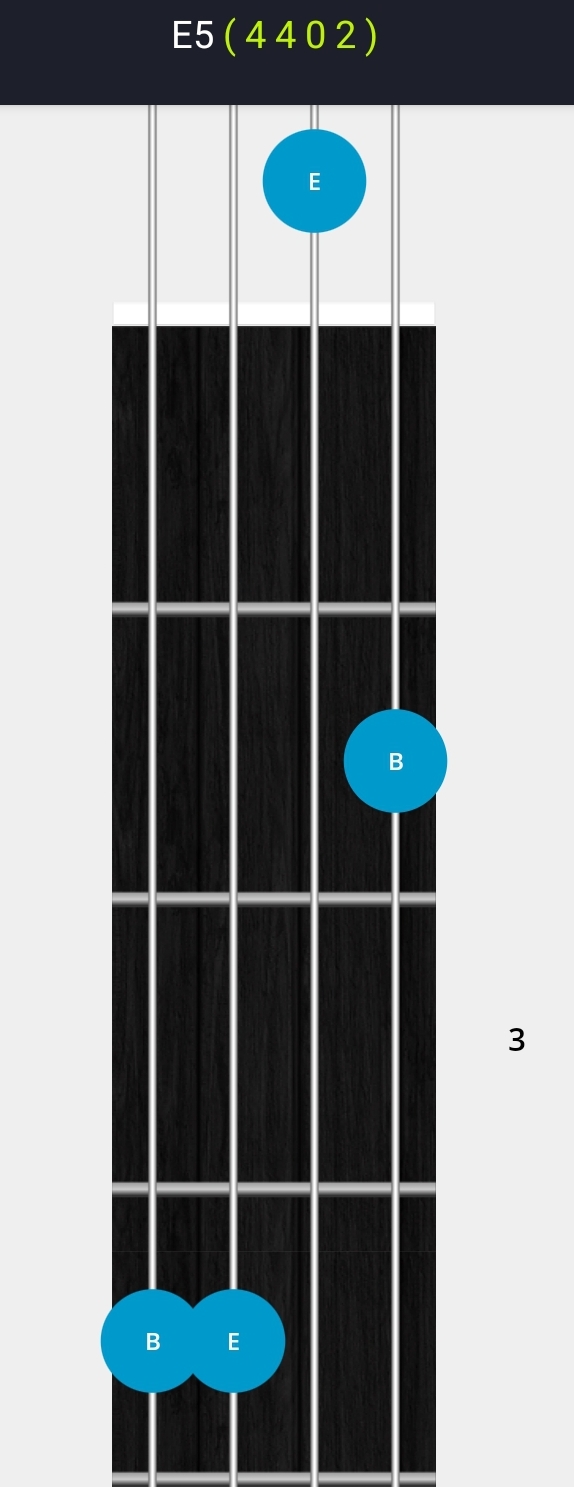
Now, if both these still exceed your finger stretching ability, then head on down to Option 5.
Option 5: Eadd11
If you can play the open D chord (2220) then keep that shape and scoot on down to the fourth fret, which will give you 4440, which is technically Eadd11.
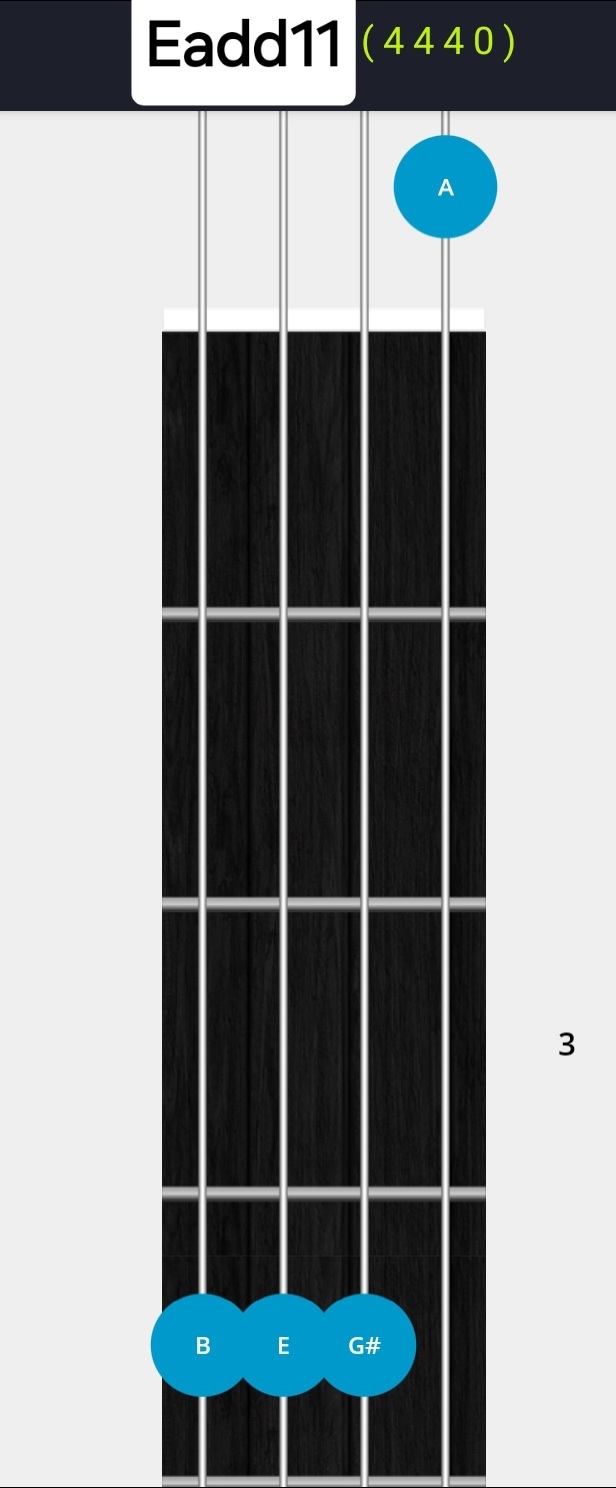
If this sounds a bit off to your ears (it's a jazz chord), then don't strum or pick the 1st string. Remember what I said earlier about Xs and removing a finger.
Option 6: D Tuning
Okay ... don't laugh. You can use a different tuning. I have at least one ukulele in D-tuning. Check out the E chord in this, the original ukulele tuning. Wahoo 🥳!
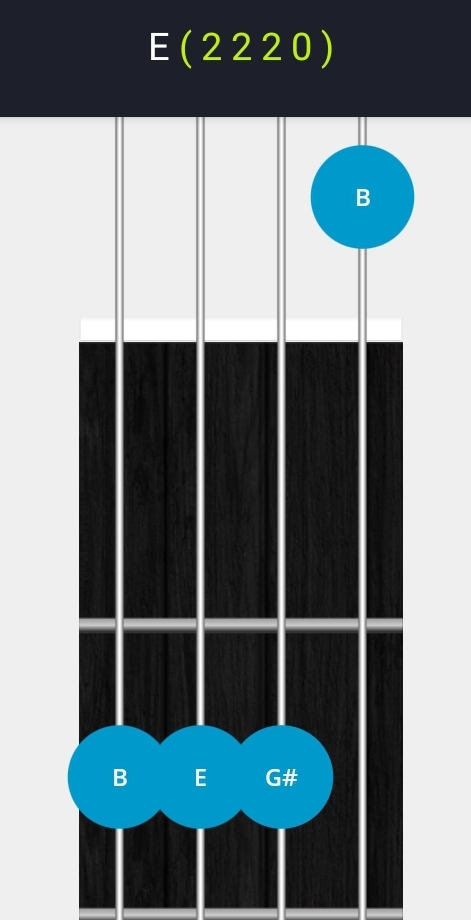
However, if you don't like Bb in C-tuning, then you won't like C in D-tuning 🤣. There is always a trade-off.
-
The B FLAT Chord
As the key of F invariably has the need for the Bb chord, you will come across this chord early on in your ukulele journey. It will probably be the first chord you meet which indicates that you are to fret two (or four) strings with the same finger. Technically a half-barre chord, which can also be played full-barre. Up till now you've been keeping one string at a time under your fingertips to get a nice clean sound.
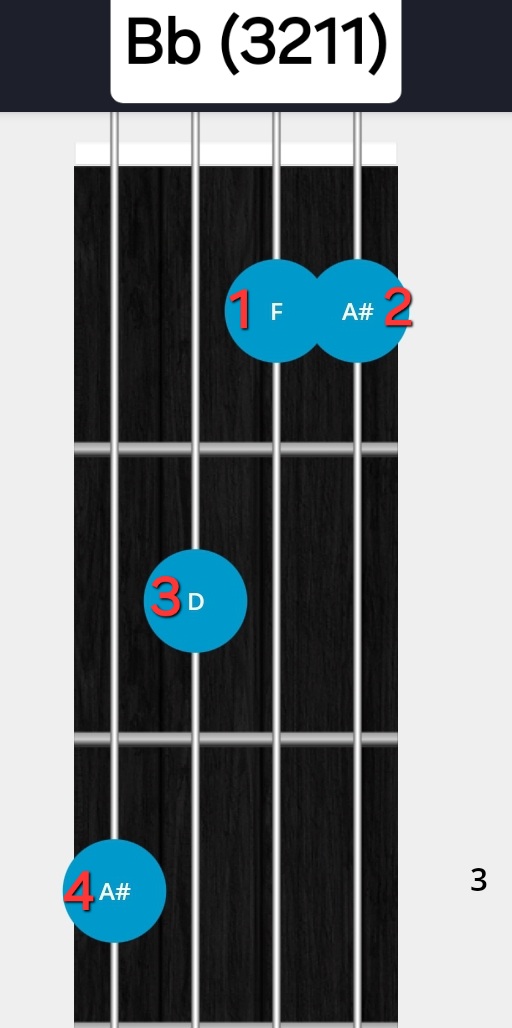
Please note: My ukulele chord diagramme generator uses the sharp enharmonic for flat chords. So, Bb is depicted as A#.
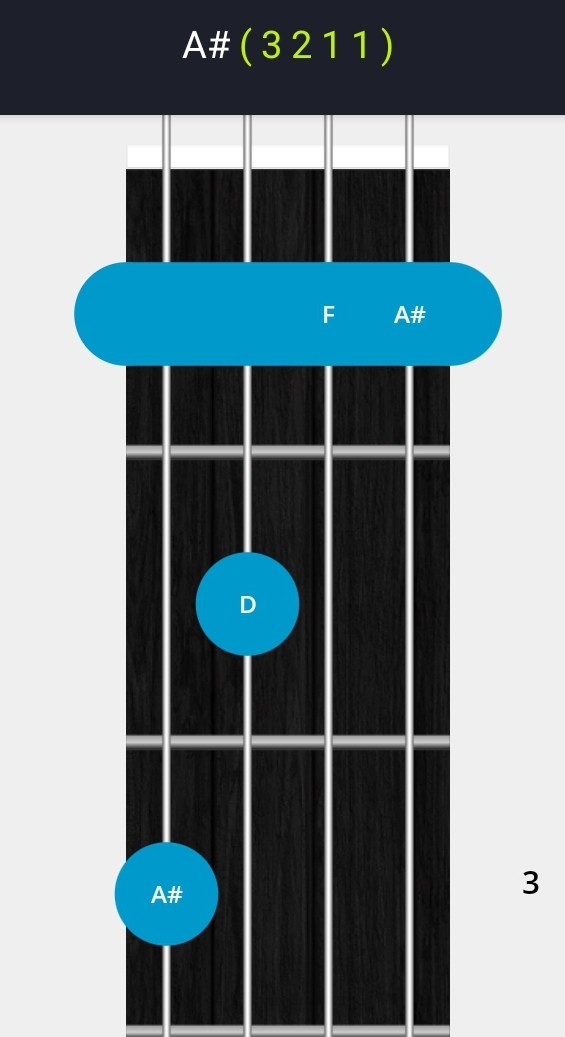
The Bb chord shown is the full-barre version, but I usually play it half-barre.
But like everything, there are alternatives.
Option 1: All Fingers
You can of course use all four fingers to play the chord. This is actually good practise for strengthening your fourth finger, plus giving it a slight stretch at the same time.
Option 2: Bb6
Bb6 is an easier option as it doesn't involve all fingers as in Option 1.
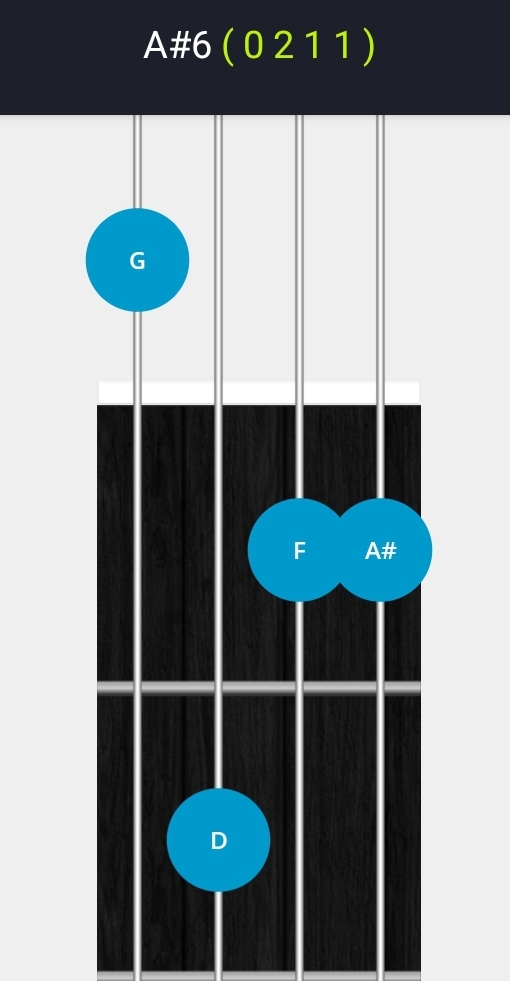
Plus, if you want to attempt the half-barre it's easier when only two fingers are involved. Having one finger 'lay down' and then two others form the 'steps' chord formation is harder than just two fingers getting all the action.
How did you get on? Next it's just a case of adding in the additional finger when you're ready to go the whole way with either a half- or full-barre Bb chord.
Barre chords will be covered in more detail in the Harmony course.
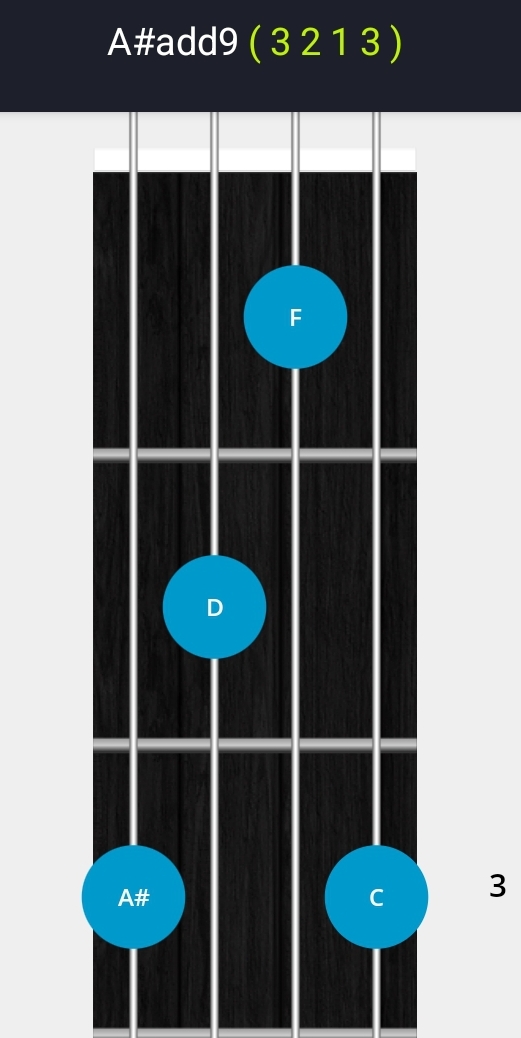
Option 3: Bbadd9
This is a nice alternative, even if in my head I read it as the Bad 9 chord 😅. This chord also makes your fourth finger useful. This finger's sole purpose in life is not to hold itself in the correct position whilst drinking a cup of tea 😅.
Time for a Song
Here is a song that not only uses this particular Bbadd9 fingering from Option 3, but once your fourth finger is in position it can stay there for the whole song, as it is used in all the chords for this song. Yep, true story! Now how about THAT fourth finger! Your time has come!!!
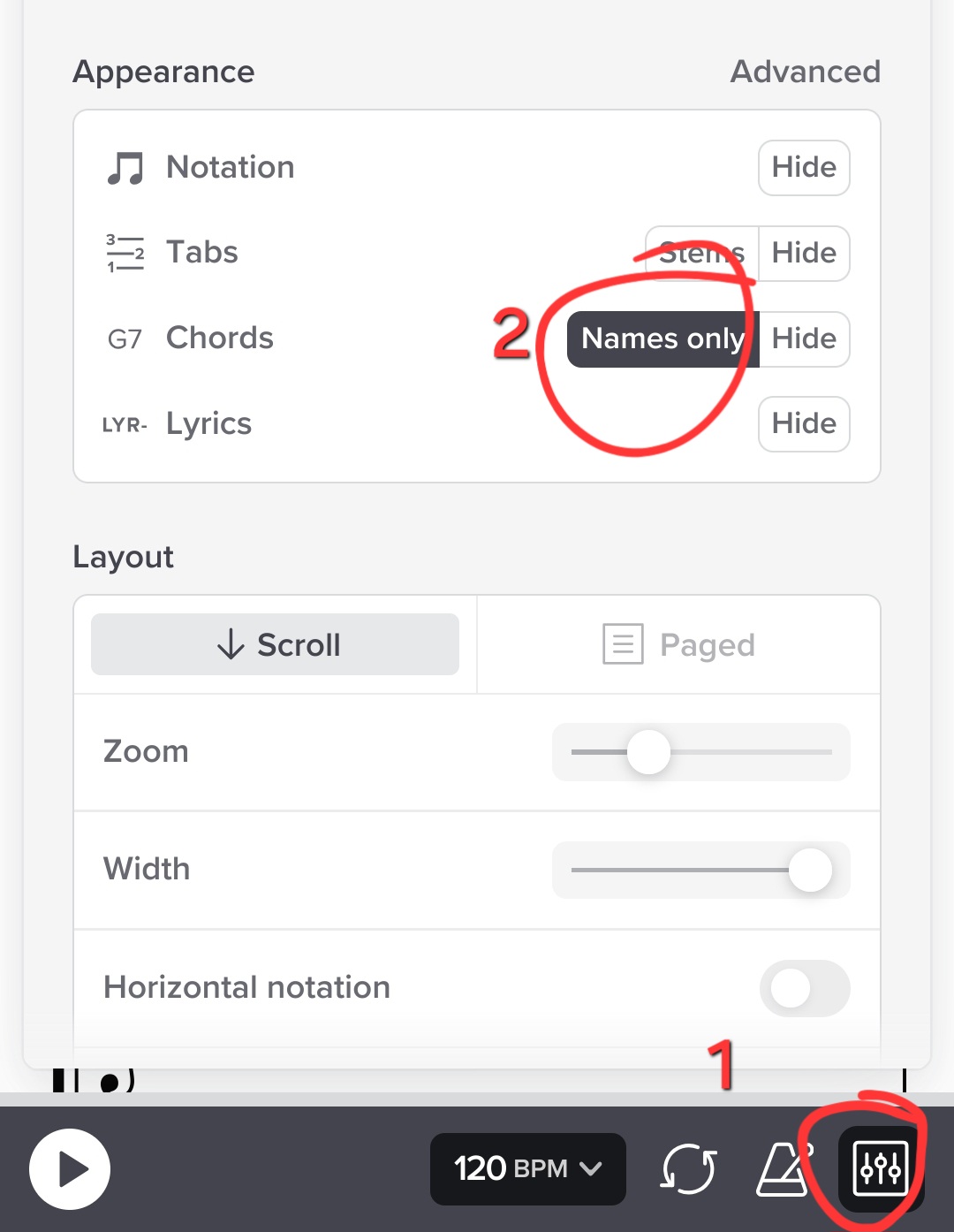
Make sure you turn on the chord diagrammes once SoundSlice loads.
A traditional American 19th Century dance song. So get up and boogie 🤣.
This song will be revisited in the Rhythm course, where I'll show you how to add hammer-ons and pull-offs to spice up this song. Plus, by keeping your fourth finger 'parked' you now have three fingers to fret other notes whilst strumming the C chord.
This song will also make an appearance when we cover scales (the pentatonic in particular) in the Music Knowledge course. Who would have guessed that such a simple song could have so many uses! Exciting times ahead 🥳!
-

Maximising Musicality
Top Block Position
Bottom Block Position