-
Minimise Movement
-
One way we can maximise musicality is to Minimise the Movement required when changing chords. Why is this important?
- Speed-up chord changes at increased tempos
- Keeping an 'anchor' so that you don't need to look or miss-fret a chord
- Save your fingers' energy -> endurance 😂
The examples that follow are taken from the song Give My Regards to Broadway. -
Example 1: G to G7
This example and those that follow are for a C tuned (gCEA) ukulele. The first transition is a common one: G (0232) to G7 (0212).How many finger movements are needed to change chords? -
Example 1: G to G7 Solution
You probably figured out how to make the transition from G (0232) to G7 (0212) with either six or two moves, as these moves just require regular fingerings.
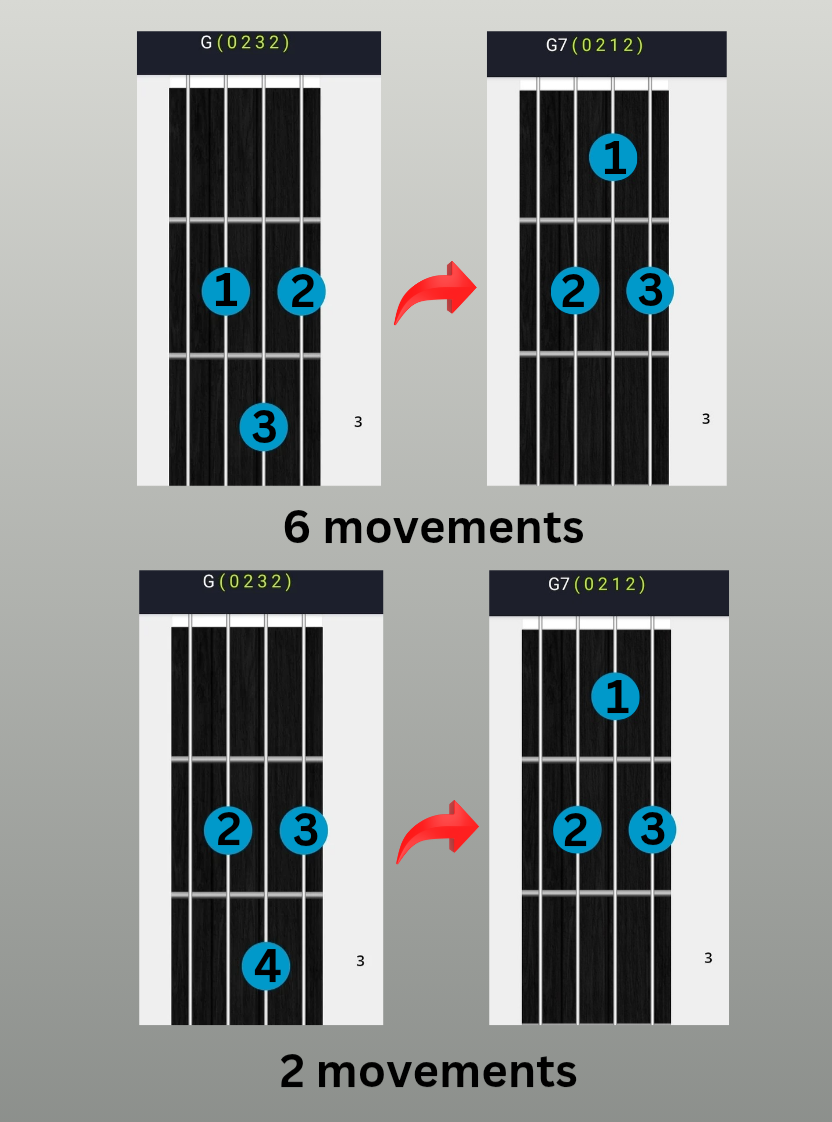
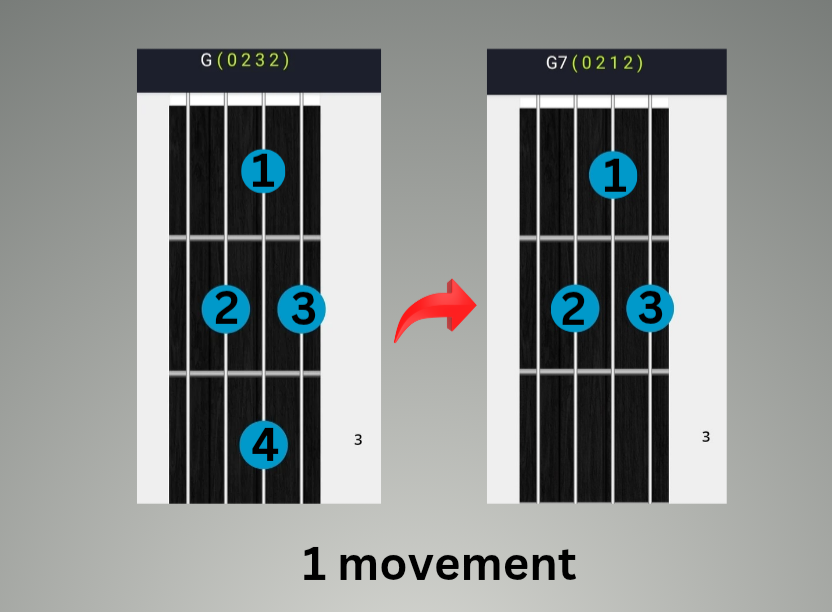
But how can you make this transition with just one movement?
It involves anticipation, or looking through the order of the chords for the tune you're going to play. And knowing that you can have more than one finger on a string at the same time as only the highest fretted note will be sounded.
-
Example 2: G to Em
The second example builds upon the previous, except this time one chord remains and morphs into another. Curious? Watch the video 📹😁
-
Example 3: G to Cm
This final example - once again - builds on the previous examples. If you thought we'd covered all the ways you could play G (0232) .... well, maybe we haven't 😉
-
The Music Video
Give My Regards To Broadway, written by George M. Cohan in 1904. The arrangement is by James Hill, and the chord fingerings are mine.
These are the fingerings that make for smooth, rapid, chord changes, but how you choose to play it is up to you. There is a simple walk-down from G4 to F4 which leads into the E7 (within the chorus) if you wish to include it.
If you'd like to repeat the last phrase as an outro, you can do another walk-down on the G string to lead into the E7. If you're playing a low G instrument it's B3 to A3, otherwise B4 to A4 for re-entrant tuning. I use fingers 4, 3, and 2 in order.
So that you can slow down the video plus sing along should you wish to, I'm not singing. Besides, I can't sing this high and I'd need to sing in a different (lower) key 😂.
-
Soundslice: Give My Regards To Broadway
-

Maximising Musicality
Top Block Position

Bottom Block Position